

Imagine installing an off-grid solar system and expecting the batteries to power your home overnight, only to have them run out before morning. Adding more batteries can extend backup time, but it does not create more solar energy. If PV generation and charging capacity do not match the battery bank, the batteries may not return to the target state of charge during low-sunlight periods.
So, how many batteries are actually needed? The right quantity comes from four factors: how much electricity you use, how long backup power must last, how much battery capacity is usable, and how much energy is lost.
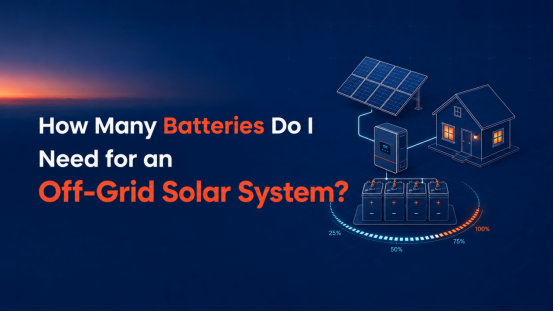
This guide explains the calculation, inverter matching, and PV charging check in clear steps.
How Many Batteries Do I Need for an Off-Grid Solar System?
No property has a standard battery quantity. Battery quantity comes from required stored energy, not inverter wattage. An off-grid solar system should be sized around this backup task before a battery model is chosen. Use:
Required nominal battery capacity = Daily critical-load energy × Backup days ÷ (Permitted DoD × System efficiency)
Permitted Depth of Discharge (DoD) is the usable share of nominal capacity. System efficiency covers battery discharge, inverter conversion, and wiring losses. An off-grid inverter’s kW rating shows how much power it can supply at one time, but not how many batteries are required.
Example:
Selected loads use 10 kWh per day and need two days of backup. With 80% permitted DoD and 90% system efficiency:
10 × 2 ÷ (0.8 × 0.9) = 27.78 kWh
With 5 kWh nominal modules:
27.78 ÷ 5 = 5.56, so use six modules.
Use manufacturer-stated DoD, temperature-adjusted capacity, and aging data. This result is the nominal-energy target for an off-grid solar system. If a battery is already rated in usable kWh, do not apply DoD again. This is a no-PV autonomy estimate; if PV is expected during the backup period, use a day-by-day energy balance and include inverter standby consumption.
How Is Required Battery Capacity Calculated?
Required battery capacity comes from energy use, while inverter power determines what can run at one time. Battery capacity is measured in kWh; inverter output is measured in kW. The following two steps turn actual appliance use into the daily energy figure used in the battery-capacity formula.
1. Calculate the Energy Used by Each Appliance
Daily energy use = Appliance input power × Operating time
Use measured input power where possible. A 100 W light used for five hours consumes 0.5 kWh; a 1,000 W pump running for two hours consumes 2 kWh. Refrigerators cycle on and off, so use actual daily consumption or a realistic duty cycle.
2. Decide Which Loads Really Need Backup
The battery bank does not necessarily need to power every appliance. Use the following categories to review your equipment and build a backup-load list based on your actual needs.
Load type | Examples | What to check |
Essential | Refrigerator, router, security system | Daily kWh and required operating time |
Scheduled | Lighting, computers, water pump | Required running hours |
Flexible | Laundry, irrigation, tools | Can operation be shifted to sunny hours? |
High-energy | Heater, oven, large air conditioner | Is battery backup necessary? |
Add only selected loads to the total. This prevents an off-grid solar system from storing energy for appliances that can run during sunny hours or from another source.
Motor-driven loads need a separate check. The solar battery and off-grid inverter must support both running demand and the verified short-duration starting demand.
How Should the Battery Bank Match the Inverter?
An off-grid solar system needs enough energy and enough DC power. A solar battery bank can store the calculated kWh yet still be unsuitable if its operating voltage, BMS limit, or discharge current does not match the inverter and loads.
1. Understand Series and Parallel Connections
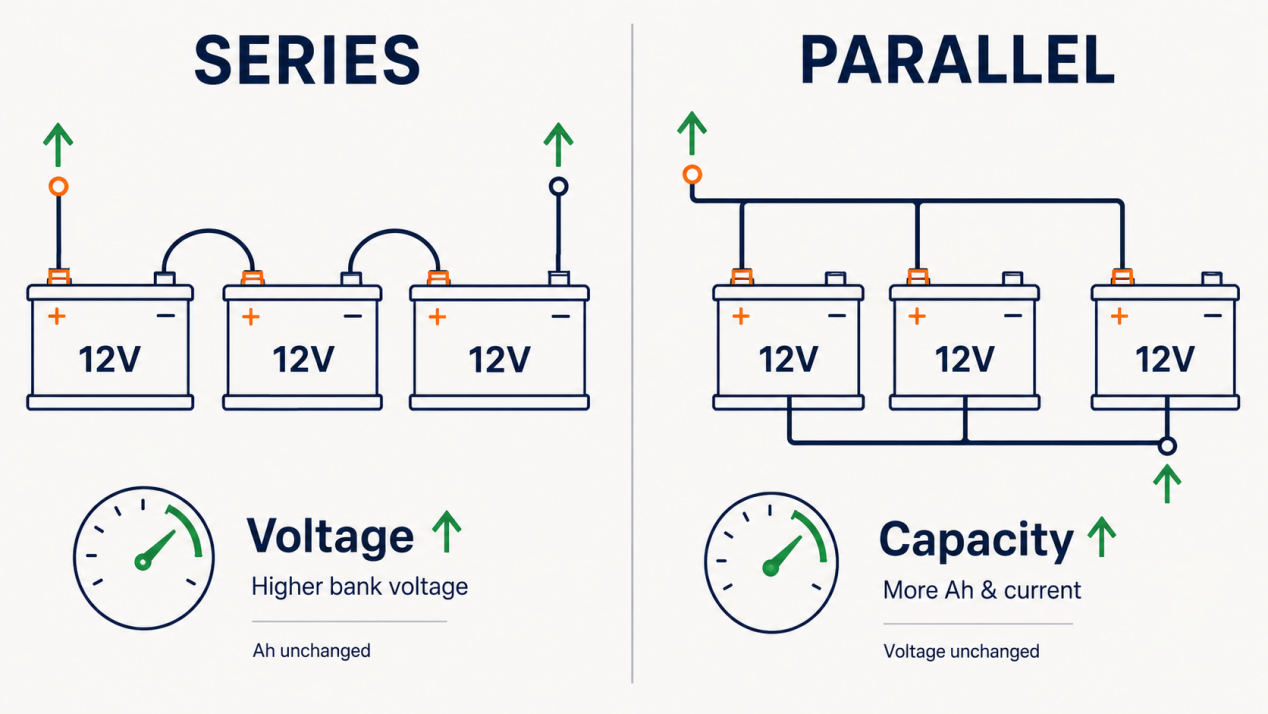
The connection method changes the voltage or capacity of the battery bank:
Connection | What it changes |
Series | Raises bank voltage; amp-hour capacity of one string stays the same |
Parallel | Increases amp-hour capacity and available current where approved by the battery manufacturer |
For example, four matching 12 V batteries in series form a 48 V bank. Matching strings may be connected in parallel for more capacity where the battery manufacturer permits it.
2. Check Battery and Inverter Compatibility
Before installation, confirm:
l Battery-bank operating voltage matches the inverter DC input range.
l Battery BMS, cables, fuses, and disconnects support continuous and peak current.
l The inverter supports expected running power and motor starting demand.
l The series and parallel arrangement, plus BMS communication, are approved for the selected battery and inverter.
These checks help confirm that the solar battery bank can supply the required loads, not simply store the calculated amount of energy.
Can the PV Array Recharge the Battery Bank?
Homes mainly need overnight essential power, while farms, small businesses, and remote facilities may also operate pumps or tools. In either case, an off-grid solar system needs PV energy for daytime loads and solar battery storage.
First, estimate usable PV generation at the battery-side DC bus after PV-side wiring and MPPT conversion losses. Convert daytime loads to the same DC-side basis before subtracting:
PV energy available for charging = Usable PV generation − Daytime energy use
Battery energy restored = PV energy available for charging × Battery charge efficiency
The restored energy must be sufficient to replace the previous battery discharge. Do not count the same wiring, MPPT, battery-charging, or inverter-conversion loss twice.
.
Check whether the off-grid solar system can recharge during the lower-sun design period rather than on a clear day. Seasonal irradiation, shading, orientation, temperature, and soiling can reduce output. Add PV capacity, shift flexible loads, or use an available AC or generator charging source where needed.
Recommend FRECON SP600
Once battery capacity and PV generation are defined, the inverter needs to put that plan into daily operation by managing battery charging and delivering power to the selected loads.
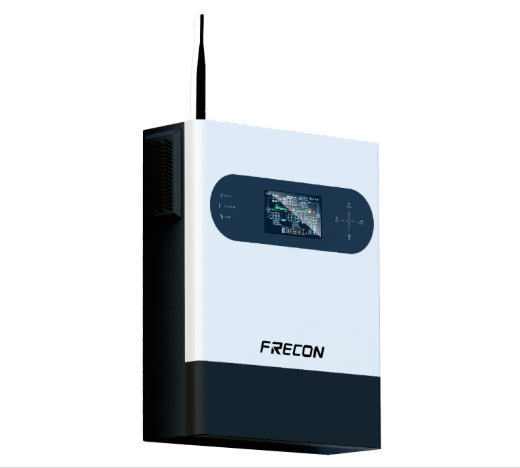
The FRECON SP600 combines an inverter, solar charger, and battery charger in one unit for this role.
1. Flexible Charging Control
The SP600 has a built-in 100 A MPPT charger. Its LCD interface allows users to set charging current and select AC or solar charging priority, helping the system use available PV and external power sources according to the chosen operating plan.
2. Battery Connection and Expansion
The SP600 supports battery equalization and BMS communication. For lithium batteries, confirm communication compatibility with the selected battery, and use battery equalization only where the battery documentation permits it.
Up to six units can operate in parallel when the project needs more inverter output, while the solar battery bank continues to determine backup duration.
3. System Monitoring
Built-in Wi-Fi supports remote monitoring of system data. The dry contact output can connect with external monitoring or building-automation logic, helping integrate the inverter into a wider off-grid solar system.
Conclusion
The right battery quantity depends on critical-load energy, backup time, permitted DoD, and system efficiency. A complete off-grid solar system also needs the right battery voltage and discharge capability, inverter support for running and starting loads, and realistic PV recharge capacity.
Good solar battery storage planning connects these checks before equipment is selected.
Contact FRECON to discuss a suitable off-grid inverter solution and system configuration for your energy demand, battery bank, and PV array.
References
[1] County of Santa Cruz. Off-Grid Solar Requirements.
https://cdi.santacruzcountyca.gov/UPC/BuildingPermitsSafety/ApplyforaBuildingPermit/Solar(PV)SystemBatteryPermits/Off-GridSolarDesign/Off-GridSolarRequirements.aspx
[2] U.S. Department of Energy. Photovoltaic System Design and Energy Yield.
https://www.energy.gov/cmei/systems/photovoltaic-system-design-and-energy-yield