
Off-grid solar now does far more than power a few lights in remote and unreliable-grid markets. An off grid solar system is increasingly expected to support essential loads: homes and farms rely on it for appliances and pumps, while businesses, telecom facilities, and monitoring sites need continuous power.
This wider role reflects a clear market shift. Off-grid solar is moving beyond basic household electrification toward higher-capacity, application-specific systems designed for larger loads, longer operating hours, battery storage, and multiple power sources.
This article examines the main growth drivers, global outlook, market impacts, and system-planning strategies for 2026, providing practical guidance for matching system capacity and inverter capabilities with actual application needs.
Why Is the Off-Grid Solar Market Expanding?
Two forces are accelerating this change: grid instability and rising loads are increasing demand for decentralized solar and storage, while energy-access programs are expanding investment in grid-connected and off-grid solutions.
1. Demand for Reliable Electricity
Grid instability becomes more disruptive as homes and businesses add refrigeration, pumps, tools, and communications equipment. An off grid solar system with storage keeps priority loads operating without complete dependence on the grid or fuel deliveries. Demand is therefore growing in unreliable-grid locations as well as areas without access.
2. Policy and Investment Support
Energy-access policy treats grid expansion and decentralized generation as complementary. Mission 300 combines grid connections, renewable mini-grids, and off-grid systems to expand African electricity access by 2030. This mobilizes investment for households, enterprises, public facilities, and remote communities.
What Is the Global Off-Grid Solar Market Outlook?
These drivers are expanding the market ecosystem, encouraging higher-capacity investment, and shifting future demand toward commercial and application-specific projects.
1. Market Scale, Competitive Structure, and Key Participants
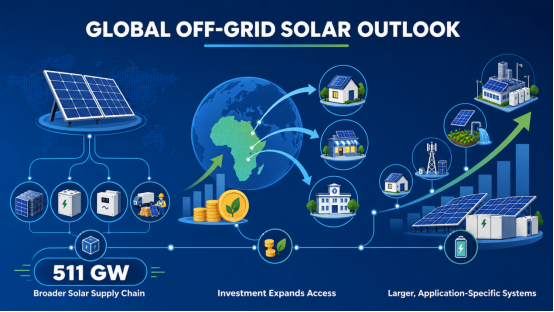
Solar accounted for 511 GW of renewable capacity additions in 2025—about 75% of the global total. Although this figure covers all solar applications, it indicates the scale of the broader supply chain supporting distributed and off-grid projects.
The off grid solar system market connects module, battery, and inverter manufacturers with integrators, developers, distributors, and installers. For buyers, competition increasingly extends beyond component prices to system compatibility and technical support.
2. Capacity, Investment, and Technology Development
Energy-access policy treats grid expansion and decentralized generation as complementary. Mission 300 supports both grid infrastructure and distributed renewable energy solutions to expand electricity access across Africa by 2030. It is also mobilizing investment in projects serving households, enterprises, public facilities, and remote communities.
3. Market Changes and Future Outlook
Commercial and large-scale adoption is accelerating in weak-grid markets such as South Africa and Pakistan. This trend suggests that future off grid solar system demand will increasingly include larger PV arrays, more storage, and configurations for business, telecom, agricultural, and infrastructure loads. Household access remains important, but reliability and integration will shape more purchasing decisions.
How Is Market Growth Affecting Different Applications?
This shift affects applications differently. Homes and small businesses need reliable power, while commercial and remote projects require coordination among PV, batteries, additional sources, and external equipment.
1. Homes and Small Businesses
Larger appliances raise daily consumption and peak demand. An off grid solar system for this group needs stable AC output, battery backup for evenings or outages, and capacity for simultaneous loads. The selected off grid solar inverter must also handle motor-starting surges from pumps or refrigeration compressors.
2. Commercial and Remote Projects
Commercial and remote installations often operate for longer hours and face greater interruption risks. They require wider PV compatibility, battery management, and settings that coordinate solar, batteries, grid supply, or generators. An off grid inverter may also exchange signals with alarms, fans, generators, or controls, making external integration a core requirement.
What Should Off-Grid Solar Buyers Consider?
Market growth affects users and project suppliers differently, so planning must connect the load profile with component compatibility. End users translate electricity needs into system capacity, while developers and distributors verify that the complete architecture can deliver it.
1. For End Users
Use the following checklist to size an off grid solar system:
l Calculate total daily electricity consumption.
l Identify peak and motor-starting loads.
l Define the required backup duration.
l Estimate usable battery capacity.
l Size the PV array according to energy demand, local solar resources, and seasonal variation.
These factors must be calculated together. Sufficient daily energy does not necessarily guarantee enough peak power or backup time.
2. For Project Developers and Distributors
Confirm that the off grid solar inverter fits the complete system architecture:
l PV compatibility: PV string voltage and array configuration
l Load and battery compatibility: Continuous output, surge demand, and battery voltage
l Output and source control: AC output quality and solar, battery, and AC priorities
l Installation: Wiring, protection, operating conditions, and commissioning requirements
l Technical support: Specification sheets, manuals, and troubleshooting assistance
The off grid inverter must work with every component. Incompatible voltage ranges or control settings can restrict performance and complicate commissioning.
Recommend the FRECON SP520 PLUS Off-Grid Solar Inverter
As off-grid solar moves toward higher-capacity, application-specific systems, inverter requirements are expanding from basic power conversion to the coordinated management of PV, batteries, AC sources, and external equipment.
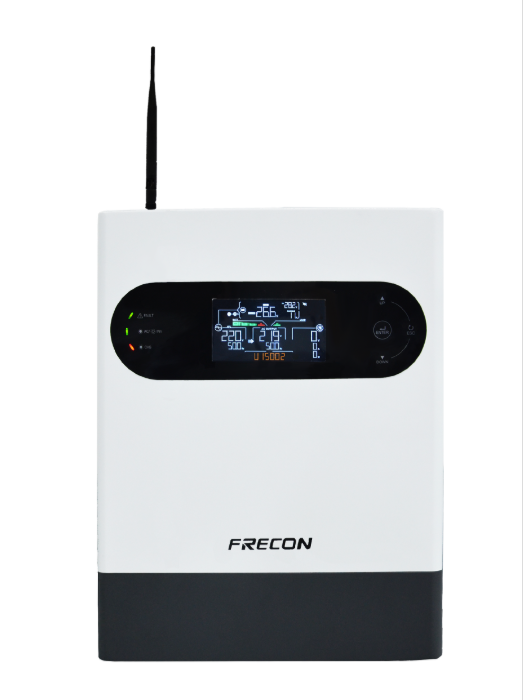
The FRECON SP520 PLUS responds to these requirements through the following official capabilities.
Market Requirement | SP520 PLUS Capability | Project Value |
Stable power and integrated solar charging | Pure sine wave output and built-in 100A MPPT controller | Combines stable AC supply with solar-energy utilization |
Flexible PV array design | 120–500 VDC PV input range | Allows more compatible panels in series and reduces parallel wiring complexity |
Battery, source, and equipment coordination | LCD battery and AC/solar priority settings, battery equalization, and dry-contact output | Supports source control, battery operation, and isolated signaling to compatible external equipment |
How Does This Off Grid Solar Inverter Support Current Projects?
These combined capabilities become more relevant as an off grid solar system expands to support larger loads, longer operating hours, and multiple power sources. Instead of addressing AC output, solar charging, battery control, and external signaling through separate design decisions, the SP520 PLUS brings them together within one power-management platform.
This makes the off grid inverter suitable for residential, telecom, backup, and remote projects that require more than basic household electrification. Final selection should still be based on the project’s PV array, battery, load, and installation requirements.
Conclusion
The market is moving from basic access products toward higher-capacity, application-specific systems. Grid reliability, investment, distributed PV growth, and changing loads are driving the transition.
Planning an off grid solar system?
Contact FRECON to identify an inverter solution that matches your power, storage, installation, and integration requirements.
References
[1] World Bank Group. Mission 300: Electricity to Power Africa and Its Economy.
https://www.worldbank.org/ext/en/energizingafrica
[2] International Renewable Energy Agency. Near-700 GW Surge in 2025 Proves Renewable Energy Resilience.
https://www.irena.org/News/pressreleases/2026/Apr/Near-700-GW-Surge-in-2025-Proves-Renewable-Energy-Resilience
[3] International Energy Agency. Renewable Electricity—Renewables 2025.
https://www.iea.org/reports/renewables-2025/renewable-electricity