

Key Takeaways
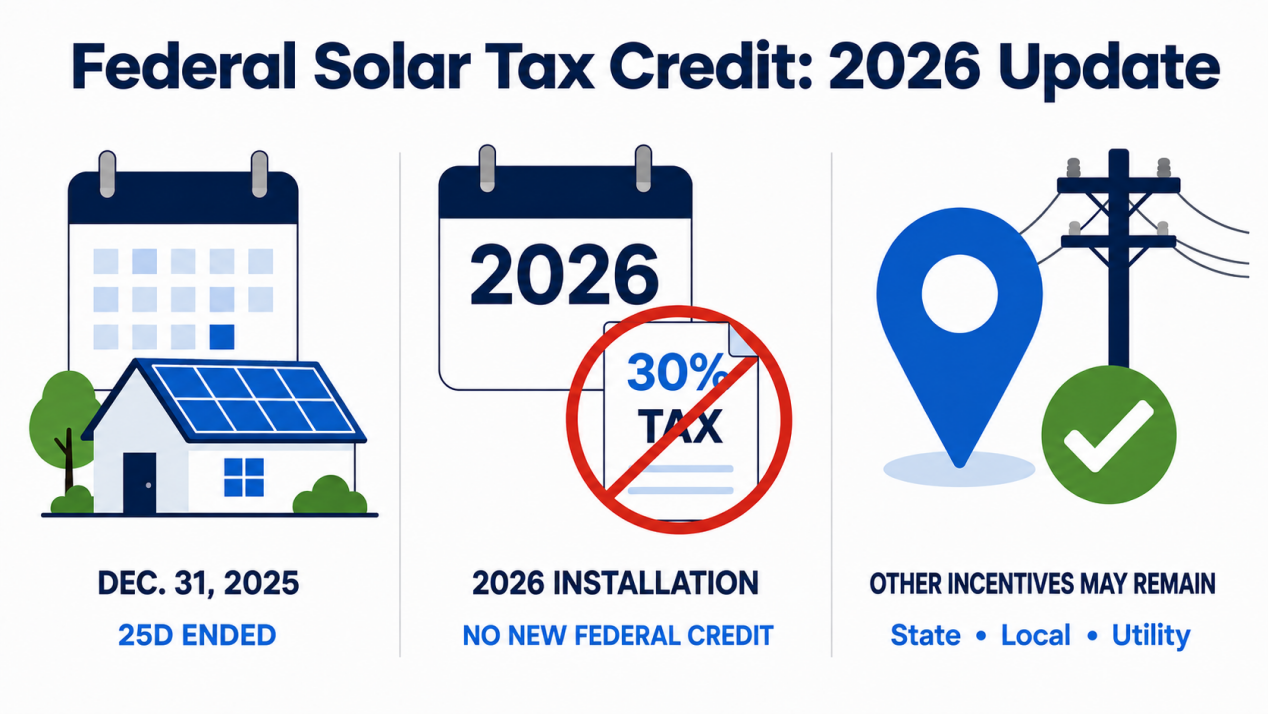
· Homeowners cannot claim a new Section 25D credit for expenditures made after December 31, 2025.
· Eligible unused 2025 credit may carry into 2026 under the federal solar tax credit 2026 rules.
· A qualifying third-party owner under a solar lease or PPA—not the homeowner—may claim Section 48E.
· Commercial federal tax credits for solar remain subject to construction timing, labor, and filing requirements.
Is the Federal Solar Tax Credit Expiring in 2026?
The homeowner credit did not expire during 2026; it had already ended when 2026 began. Section 25D does not apply to expenditures made after December 31, 2025. Therefore, a homeowner cannot generate a new credit for a solar installation completed in 2026, whether it is purchased with cash or financed through a standard loan.
l The OBBBA Change
The One Big Beautiful Bill Act accelerated the termination of the Residential Clean Energy Credit. Section 25D was previously scheduled to remain at 30% through 2032 before decreasing in 2033 and 2034.
For solar property, an expenditure is generally treated as made when the original installation is completed. Paying a deposit or signing a contract in 2025 does not preserve the credit if installation is completed after December 31, 2025. This installation-completion rule is central to understanding the federal solar tax credit in 2026.
l The Financial Impact
A $30,000 solar home system with a 10kw inverter could previously generate a federal credit of up to $9,000, subject to eligibility and tax liability.
If the installation is completed in 2026, the homeowner remains responsible for the full contract price before state and local incentives. Financing changes the payment schedule and may add interest, but it does not restore Section 25D eligibility. This is the main cost change covered in this solar tax credit how to claim it 2026 guide.
l Remaining State and Local Incentives
The federal change does not automatically eliminate state tax credits, Solar Renewable Energy Certificates, property-tax exemptions, sales-tax exemptions, or utility rebates. A solar home buyer comparing federal tax credits for solar should review incentives available in the relevant state and utility territory before setting a project budget.
How Can Homeowners Still Get Solar Tax Savings in 2026?
Homeowners cannot personally claim a new Section 25D credit in 2026. However, a qualifying third-party owner may claim Section 48E on a residential rooftop system and reflect some of that value in a solar lease or PPA price.
For this solar tax credit how to claim it 2026 question, personal tax-credit eligibility must be separated from third-party ownership.
l Section 48E Mechanics
The Section 48E credit has a 6% base and can rise to 30% with labor compliance; facilities below 1 MW may qualify for an exception. A provider owning and placing a small rooftop system in service may claim it, subject to applicable rules.
l How the Economic Benefit May Reach a Homeowner
An eligible provider may reflect the credit in:
1. A lower fixed monthly payment under a solar lease; or
2. A lower per-kWh electricity price under a PPA.
Federal law does not require the provider to transfer a specific percentage of its tax benefit to the homeowner. Buyers should compare cash, lease, and PPA quotes using a similar array size, inverter category, and home solar inverter selection criteria. This makes the solar tax credit how to claim it 2026 comparison based on total contract costs rather than advertised tax-credit percentages.
l The Ownership Trade-Off
A PPA avoids high upfront spending, but the provider retains the panels and usually the battery. Homeowners cannot claim federal tax credits for solar on equipment they do not own.
So homeowners should review contract length, escalators, transfers, maintenance, and buyout terms in any solar tax credit how to claim it 2026 comparison.
How Do I Claim Carry-Forward Solar Tax Credits on My 2026 Return?
Homeowners cannot claim Section 25D for a solar system completed in 2026. However, unused credit generated by an eligible 2025 installation may still reduce tax owed in 2026.
l The Nonrefundable Credit
The Residential Clean Energy Credit was nonrefundable. It could reduce federal income-tax liability to zero, but it could not create a payment exceeding the taxpayer’s liability.
Eligible unused Section 25D credit may be carried into later tax years. This differs from the separate Section 25C Energy Efficient Home Improvement Credit, which does not permit unused amounts to be carried forward.
l How the Carryforward Works
An eligible unused balance remains available under the Section 25D carryforward rules. The homeowner does not need to make another solar purchase to preserve it.
However, the IRS does not automatically enter the balance on the homeowner’s next tax return. The taxpayer must report the carryforward when filing the 2026 return, which will generally be filed in 2027. This is the only direct homeowner filing route covered by the solar tax credit; how to claim it in 2026 once new Section 25D expenditures have ended.
l Find the Amount on the 2025 Form 5695
The 2025 Form 5695 instructions identify line 16 as the unused Residential Clean Energy Credit carried forward to 2026. Homeowners should retrieve their filed Form 5695 and use the line 16 amount when completing the final 2026 form.
Anyone using solar tax credit how to claim it 2026 as a filing query should also retain the 2025 return, installation invoices, and completion records. A qualified tax professional can confirm how the carryforward applies to the homeowner’s 2026 tax liability.
What Are the 2026 Federal Solar Incentives for Commercial Systems?
For companies researching how to claim the solar tax credit in 2026, eligibility now depends heavily on when construction begins, how that milestone is documented, and whether applicable labor requirements are met.
The Construction Deadline
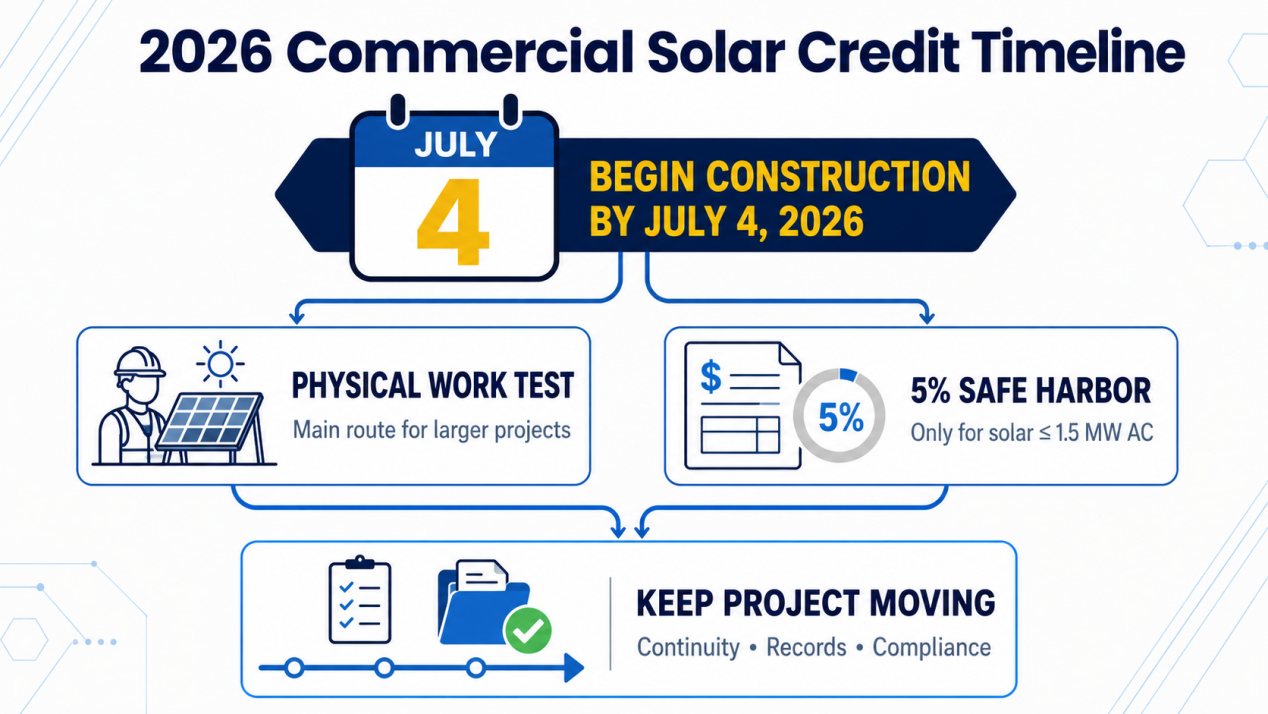
IRS Notice 2025-42 sets the relevant construction deadline at July 4, 2026. An applicable solar facility that begins construction on or before July 4 may avoid the newer credit-termination rule, provided it also satisfies the relevant continuity requirements.
Projects beginning construction after July 4, 2026, generally need to be placed in service before January 1, 2028. Missing both conditions may prevent the project from receiving the Section 48E credit.
Physical Work and the Limited 5% Safe Harbor
IRS guidance recognizes two methods for establishing when construction begins:
1. Physical Work Test: Construction begins when physical work of a significant nature starts. Qualifying work may occur onsite or involve components produced offsite under a binding written contract. Planning, permitting, financing, site surveying, and similar preliminary activities do not qualify by themselves.
2. 5 % Safe Harbor: At least 5% of the facility’s total project cost is paid or incurred before the deadline, followed by continuous efforts toward completion.
For this specific deadline, the 5% Safe Harbor is available only to a low-output solar facility with a maximum net output of no more than 1.5 MW AC. Larger applicable solar facilities generally must rely on the Physical Work Test.
Early procurement matters because compliant components and records must support filing. A solar tax credit how to claim it 2026 decision should coordinate tax, engineering, procurement, and supplier teams before capital is committed.
Conclusion
The federal solar tax credit 2026 rules create two different paths. Homeowners may use eligible Section 25D credit carried forward from 2025, while third-party owners and commercial projects may continue to pursue Section 48E under stricter timing, labor, sourcing, and filing requirements.
A reliable solar tax credit how to claim it 2026 review should therefore begin by identifying the system owner, installation or construction date, available carryforward, and applicable PFE records.
For homeowners planning to own and operate an independent residential system, explore FRECON’s off-grid solar inverter solutions to evaluate inverter options for solar generation, battery storage, and essential household loads.
References
[1] IRS. FAQs for Modification of Sections 25C, 25D, 25E, 30C, 30D, 45L, 45W, and 179D Under Public Law 119-21.
https://www.irs.gov/newsroom/faqs-for-modification-of-sections-25c-25d-25e-30c-30d-45l-45w-and-179d-under-public-law-119-21-139-stat-72-july-4-2025-commonly-known-as-the-one-big-beautiful-bill-obbb
[2] IRS. Residential Clean Energy Credit.
https://www.irs.gov/credits-deductions/residential-clean-energy-credit
[3] IRS. Clean Electricity Investment Credit.
https://www.irs.gov/credits-deductions/clean-electricity-investment-credit
[4] IRS. 2025 Instructions for Form 5695.
https://www.irs.gov/instructions/i5695
[5] IRS. Notice 2025-42.
https://www.irs.gov/irb/2025-36_IRB