

4 Applications of Pure Sine Wave Inverters
Designing an off-grid or hybrid energy system involves converting stored direct current (DC) into usable alternating current (AC). A pure sine wave inverter serves as the foundational component in modern electrical architecture, generating an AC waveform that replicates standard utility power.
Understanding what a pure sine inverter is and how it processes electrical loads clarifies its necessity for complex motor applications, sensitive microprocessors, and grid-tied solar environments. And this guide will walk it through.
What is a Pure Sine Wave Inverter and How Does Wave Quality Impact Efficiency?
A pure sine wave inverter produces a smooth, continuous AC waveform identical to utility power, typically maintaining Total Harmonic Distortion (THD) below 3%. This precise oscillation allows inductive loads to operate optimally without excess thermal resistance.
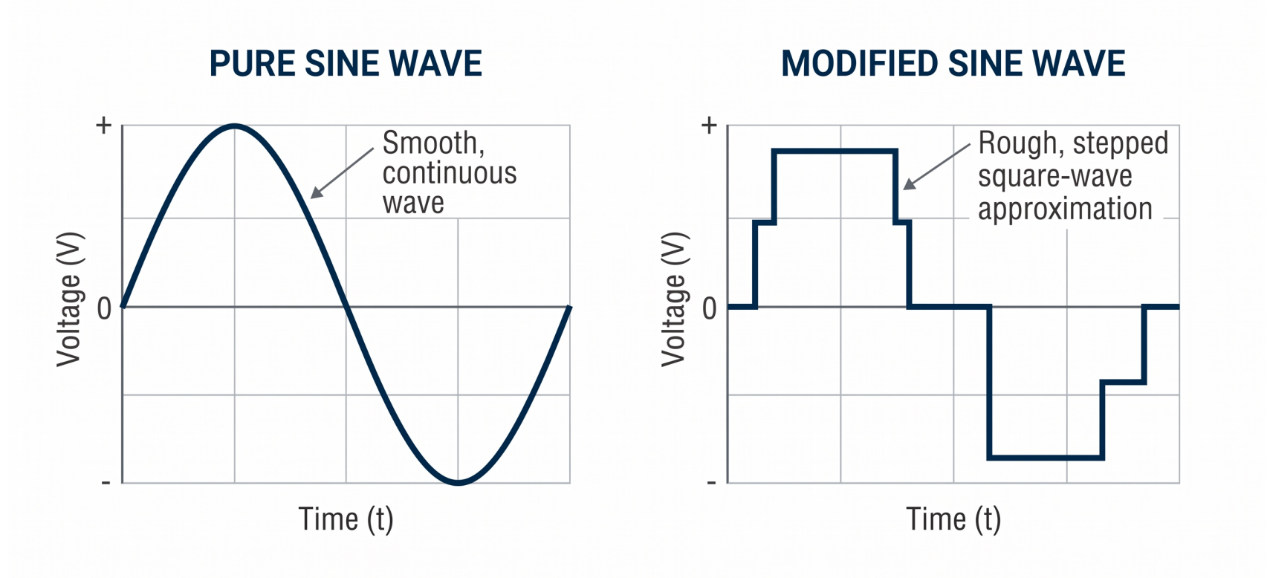
Pure Sine Wave vs. Modified Sine Wave in Waveform
The quality of the AC output dictates equipment compatibility and long-term hardware health. Inverter outputs are classified into two primary waveform categories:
l Pure Sine Wave: Produces a natural, curved oscillation that covers a full range of frequencies. This waveform mirrors the electricity supplied by standard utility grids, keeping Total Harmonic Distortion (THD) below the 3% threshold.
l Modified Sine Wave: Generates a rigid, stepped square-wave approximation that abruptly alternates between top and bottom voltage peaks. This blocky transition introduces severe harmonic distortion, typically ranging from 20% to 30% THD.
Pure Sine Wave vs. Modified Sine Wave in Efficiency
Waveform structure directly impacts the operational efficiency of connected appliances. Pure sine wave inverters maintain baseline conversion efficiencies of 85% to 95%.
Conversely, the harmonic resistance introduced by a modified sine wave causes inductive motors to consume 10% to 20% more power to achieve the same mechanical output.
This inefficiency translates into measurable heat, forcing equipment to run 15% to 20% hotter, which limits the lifespan of internal power supplies.
Parameter | Pure Sine Wave | Modified Sine Wave |
Waveform Structure | Smooth, continuous curve | Rigid, stepped square blocks |
Total Harmonic Distortion (THD) | < 3% (Utility-grade) | 20% – 30% |
System Efficiency | 90% – 95% | 70% – 80% |
Motor Heat Generation | Standard operational limits | 15% – 20% hotter |
Pure Sine Wave Inverters in Solar Energy and Hybrid Storage
Grid infrastructure relies on synchronized AC oscillations. Pure sine wave output serves as the technical baseline for syncing distributed generation systems with local utility grids and residential energy storage setups.
The Grid Match Requirement
Injecting solar energy into the public utility grid requires precise phase synchronization. Utility networks operate under strict regulatory standards (such as IEEE 519), which limit acceptable power distortion.
A pure sine wave inverter is required for grid-tied and hybrid applications, as it matches the exact frequency and voltage of the grid without introducing destabilizing harmonic noise.
System Scales and Architecture
Clean AC inversion scales across various tiers of solar infrastructure:
l Residential & Off-Grid Living: A 48V pure sine wave inverter acts as the central hybrid hub, routing power between solar panel arrays, Battery Energy Storage Systems (BESS), and the household load panel.
l Micro PV / Balcony Systems: Small string or microinverters mount directly behind solar modules, feeding clean AC power straight into standard residential wall outlets.
l Commercial / Utility: Three-phase string inverters coordinate large-scale solar generation, matching the rigid phase requirements of commercial HVAC units and industrial machinery.
Pure Sine Wave Inverters in High-Surge and Motor-Driven Loads
Inductive loads rely on electromagnetism to function. A smooth sine wave allows variable-speed drives and compressors to clear massive startup surges without triggering thermal overload.
The Motor Requirement
Electric motors, compressors, and variable-speed drives interact continuously with the AC waveform. The abrupt voltage transitions of a modified sine wave induce electrical friction within motor windings. A pure sine wave allows the motor to rotate smoothly, mitigating internal thermal stress and preventing nuisance shutdowns.
Key Appliance Categories
l Refrigeration & HVAC: Clean power allows cooling compressors and AC variable-speed motors to operate efficiently, reducing the risk of premature capacitor failure.
l Agricultural Water Pumps: Heavy-duty irrigation systems require smooth AC delivery. Industrial solutions like theFRECON PV150Aand PV500 Series Solar Pump Inverters (0.2 kW – 630 kW) utilize advanced control algorithms to drive asynchronous and BLDC water pumps directly from solar arrays. These systems operate at >99% MPPT efficiency and include dry-run protection to safeguard agricultural infrastructure.

Managing Surge Data
Inductive motor loads demand startup surges 3 to 6 times higher than their rated continuous wattage to overcome mechanical inertia. A high-capacity pure sine wave inverter is engineered to safely clear these sub-second spikes without distorting the voltage curve or dropping the AC output.
Pure Sine Wave Inverters in Sensitive Microprocessors and IT Infrastructure
Modern integrated circuits and communication hardware utilize active power factor correction. Operating these devices on modified sine waves frequently results in data corruption, signal static, and hardware degradation.
Why Pure Sine Wave Inverters
Modern electronics rely on sensitive internal power supplies that expect a perfectly curved AC input.
Feeding a jagged, modified waveform into a microprocessor-controlled device causes the internal rectifiers to work harder to filter the noise. This constant filtering generates excess heat, which degrades the integrated circuits over time.
Communication and Computing Load Profiles
l Laptops and PCs: Clean AC power allows internal active-PFC (Power Factor Correction) power supplies to function normally, avoiding thermal overload.
l Home Networks: Precision waveforms allow modems and Wi-Fi routers to transmit digital data without introducing electromagnetic interference or signal distortion.
l Audio-Visual Equipment: A pure sine wave resolves the audible static hums, buzzing speakers, and visual screen distortion commonly introduced by the harmonic noise of modified sine inverters.
Pure Sine Wave Inverters for Medical Devices, Precision Tools, and Timing Circuits
Life-safety equipment, microcontrollers, and variable-speed tools rely on exact AC zero-crossing points. Distorted wave architecture causes timers to fail and precision motors to overheat.
Life-Safety and Medical Equipment
Home healthcare devices, such as CPAP machines and oxygen concentrators, are explicitly rated for pure sine wave power. The internal pressure sensors and humidification elements require flawless, uninterrupted voltage delivery. Utilizing a modified sine wave for medical equipment carries the risk of sudden shutdown or erratic sensor behavior.
Jobsite Power Tools
Construction equipment utilizing variable-speed triggers, such as drills, angle grinders, and miter saws, rely on smooth voltage curves to modulate RPMs. When operated on modified square-wave power, the speed controllers fail to register the correct voltage, causing the tools to stutter, overheat, or run exclusively at maximum speed.
Microcontrollers and Timers
Appliances utilizing digital clocks or electronic heat sensors (such as microwaves, specialized hair straighteners, and coffee makers) use the utility grid's 60Hz or 50Hz frequency to track time.
l The abrupt voltage jumps of a modified sine wave confuse the internal zero-crossing detectors.
l This incompatibility causes digital timers to run fast, or the integrated circuits to lock up and fail entirely under localized brownout conditions.
Conclusion
The deployment of off-grid and hybrid energy architecture requires a thorough evaluation of load profiles and waveform compatibility. While pure sine wave inverters represent a higher initial hardware investment, their <3% THD output is a strict operational necessity for motor-driven machinery, modern IT infrastructure, and medical equipment.
Organizations engineering agricultural irrigation networks or commercial-grade power systems should review dedicated solutions provided by FERCON, which provide the high-efficiency, clean-wave power conversion required for heavy-duty applications.