

Energy costs rank among the largest operational expenses for industrial facilities. When motors run at fixed speeds regardless of demand, electricity is simply wasted. As FRECON, a professional company in industrial automation, energy efficiency, and green new energy, we have helped customers across countless industries reduce their power consumption through intelligent drive technology. With over ten years of experience developing inverters, servo drives, and energy-saving control cabinets, our product power range covers 0.2kW to 1MW. This article examines the actual savings achievable with proper industrial motor control strategies.
The Affinity Law and Pump and Fan Applications
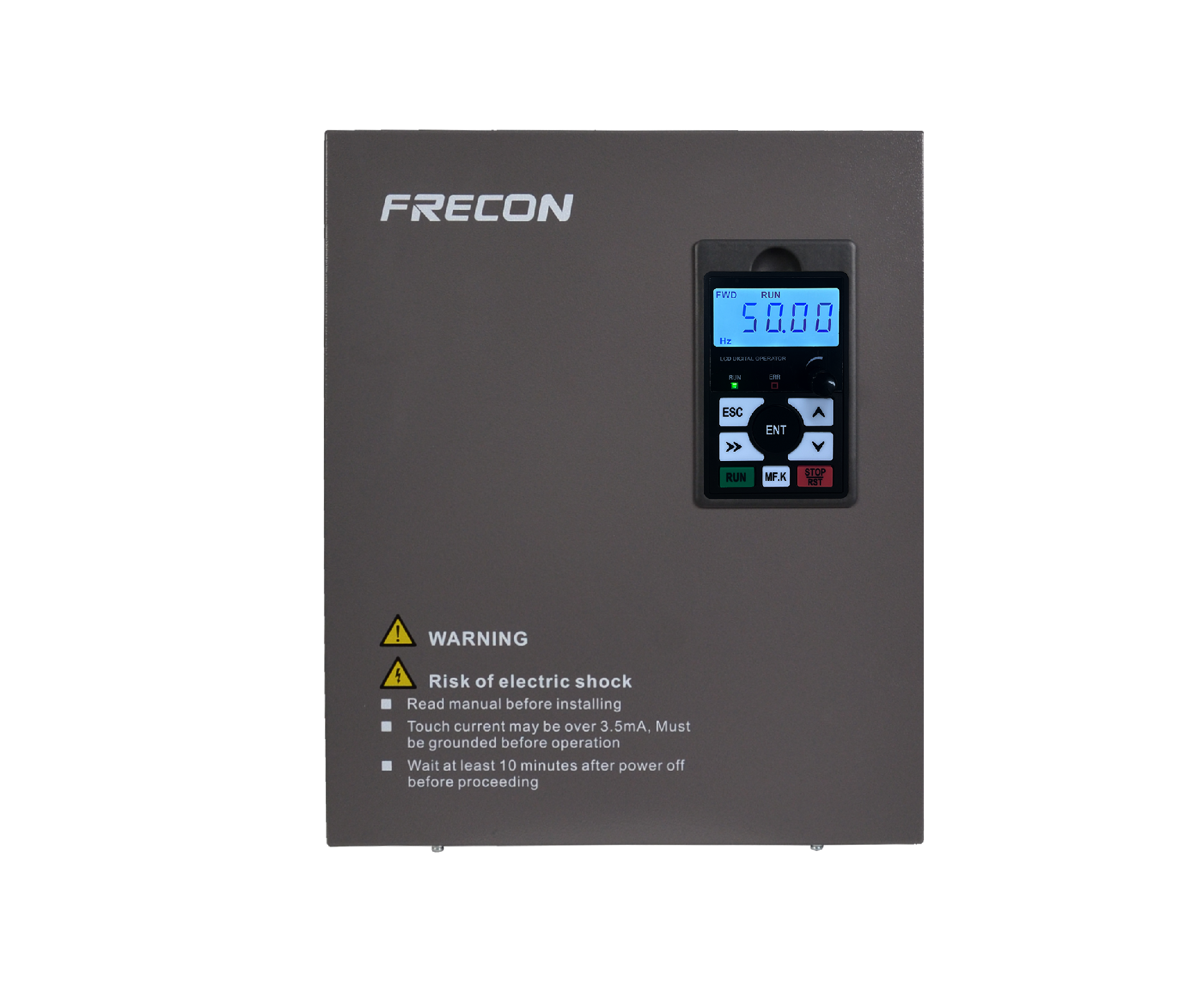
The most dramatic savings occur in centrifugal pump and fan applications. The affinity law states that power consumption changes with the cube of speed. Reducing speed by 20% cuts power consumption by nearly 50%. Reducing speed by 30% cuts power by more than 65%. For a 100 kW pump running continuously, a FRECON integrated inverter delivering 30% speed reduction saves over 65,000 kWh annually—equivalent to roughly 30 tons of CO₂ emissions. Traditional control methods like throttling valves or inlet vanes waste energy as heat across a restriction. Industrial motor control using a FRECON integrated inverter eliminates that waste entirely. Our SY380 Series Voltage Boost Inverter offers a unique built-in booster plan that maintains stable output voltage even during speed reduction, ensuring pumps and fans operate efficiently across the entire range. Compared with transformer-based solutions, the SY380 achieves smaller volume and lower cost while delivering consistent savings.
Part-Load Operation and Variable Torque Loads
Many industrial motors run at partial load for significant portions of the day. Conveyors, mixers, extruders, and positive displacement pumps fall into constant torque categories, where savings follow speed reduction linearly rather than by the cube law. Even here, industrial motor control delivers meaningful returns. A 50% speed reduction on a constant torque load cuts power consumption by approximately 50%. For a 30 kW conveyor operating at half speed for 4,000 hours annually, that saves 60,000 kWh per year. FRECON integrated inverters include automatic energy optimization algorithms that reduce output voltage under light loads, capturing additional savings beyond basic speed control. The SY380 Series further enhances this with S multiple protection, giving customers safe and reliable operation during continuous part-load duty. Additionally, S component derating design ensures long service life and high reliability, protecting your investment over years of daily use.
Return on Investment and Real-World Examples
How quickly do these savings pay back the cost of a VFD? For most pump and fan retrofits, payback ranges from six to eighteen months. For constant torque applications, payback typically falls between one and two years. A 22 kW irrigation pump with our SY380 Series achieved 55% energy reduction, with the integrated inverter paying for itself within one growing season. Compared with transformer-based voltage control schemes, the SY380's smaller volume and lower cost further shorten payback periods. These results come from proper sizing, correct programming, and reliable industrial motor control hardware—all areas where FRECON excels.
Making Energy Savings a Reality
The question is not whether a VFD saves energy, but how much. For variable torque loads like pumps and fans, expect 30% to 60% savings depending on speed reduction. For constant torque loads, savings match speed reduction percentage. FRECON brings decades of experience and products like the SY380 Series Voltage Boost Inverter—featuring unique built-in booster plan, S multiple protection, S component derating design, and smaller volume with lower cost than transformer alternatives. Our industrial motor control solutions range from 0.2kW to 1MW, all EMC and CE compliant. Contact FRECON for a free energy audit and see exactly how much an integrated inverter can save your facility.